
Where the project began
GAP began with a reading and a practical question: many principles of healthy relationships sound reasonable in the abstract, but it is difficult to recognize how they appear in ordinary behavior. I wanted to turn those principles into situations that a person could respond to and reflect on.
The product is an interactive self-observation experience, not a psychological diagnosis or a definitive judgment about a relationship.
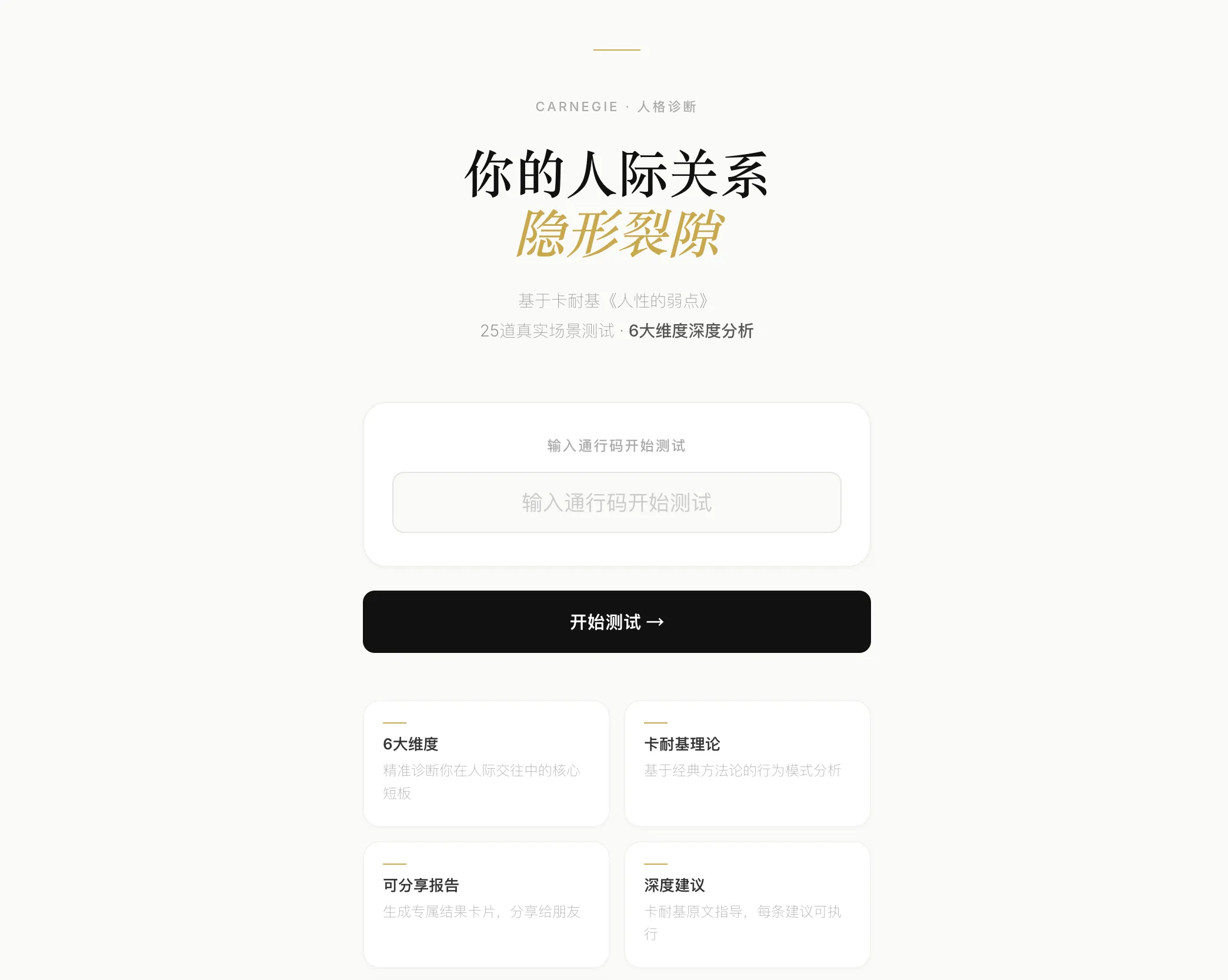
Home page: relationship situations and a clear entry point establish the product as a self-observation experience.
From one book to six observation dimensions
I reorganized the source ideas into six dimensions that could be expressed through everyday situations. The dimensions cover patterns such as boundaries, communication, emotional response, trust, reciprocity, and the ability to repair tension.
The dimensions are not clinical scales. They are a product framework for making several kinds of relational behavior visible at the same time.
How the 25 questions were designed
Each question uses a recognizable situation rather than asking users to agree with an obvious principle. Options describe different possible responses without labeling one choice as morally superior in the interface.
The questions are distributed across dimensions and weighted through explicit rules. I repeatedly reviewed wording, overlap, answer direction, and whether one question could dominate the final profile.
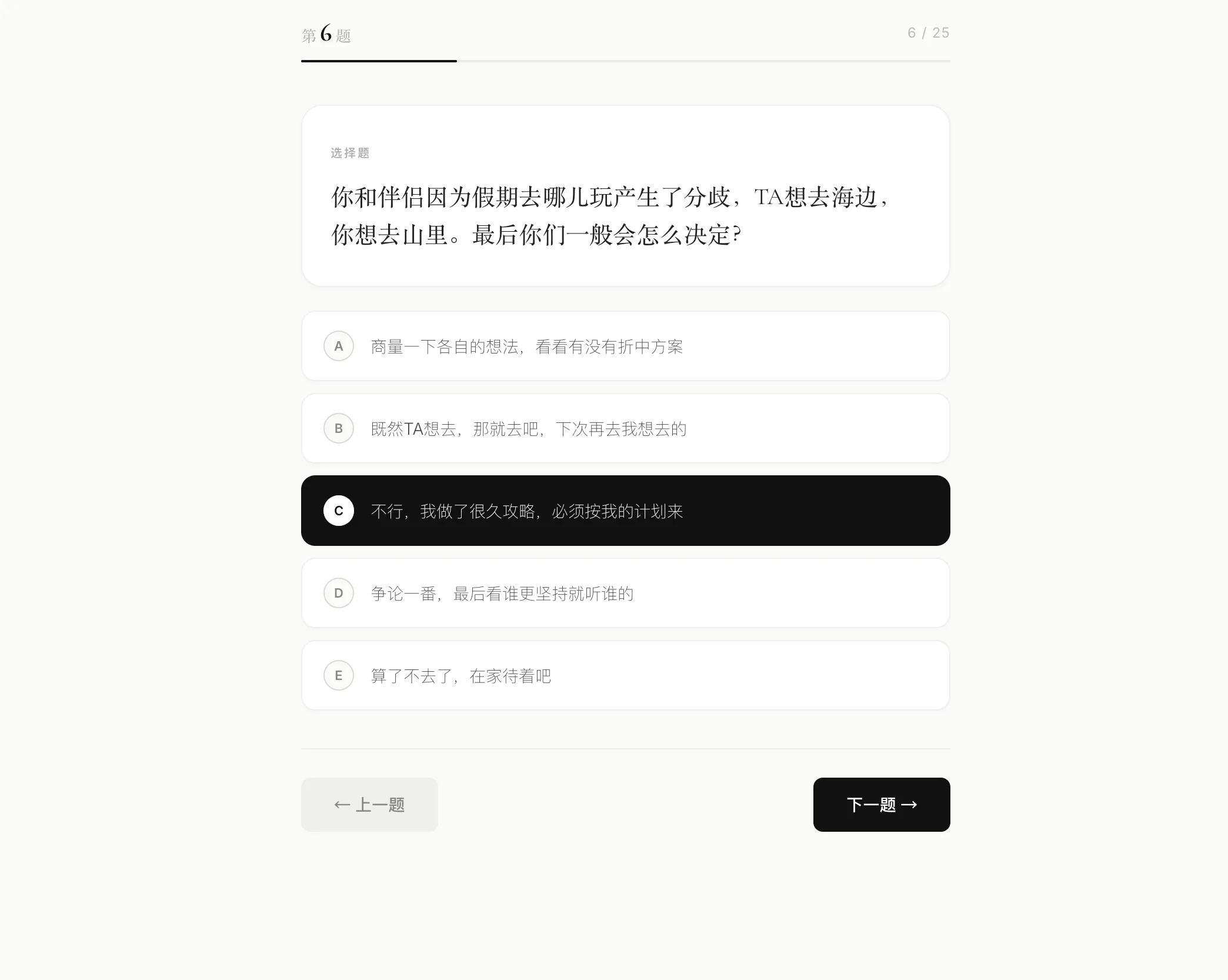
Question page: one scenario is shown at a time, with persistent question number, progress, and selection state.
Decisions in the result page
The result is not reduced to a single score. It combines an overall interpersonal-health index, a six-dimension chart, layered interpretation, and concrete observations. Lower results are written as areas to notice rather than fixed defects.
The page connects each dimension to possible action while keeping the boundary clear: a short interactive test cannot explain the full history or context of a real relationship.
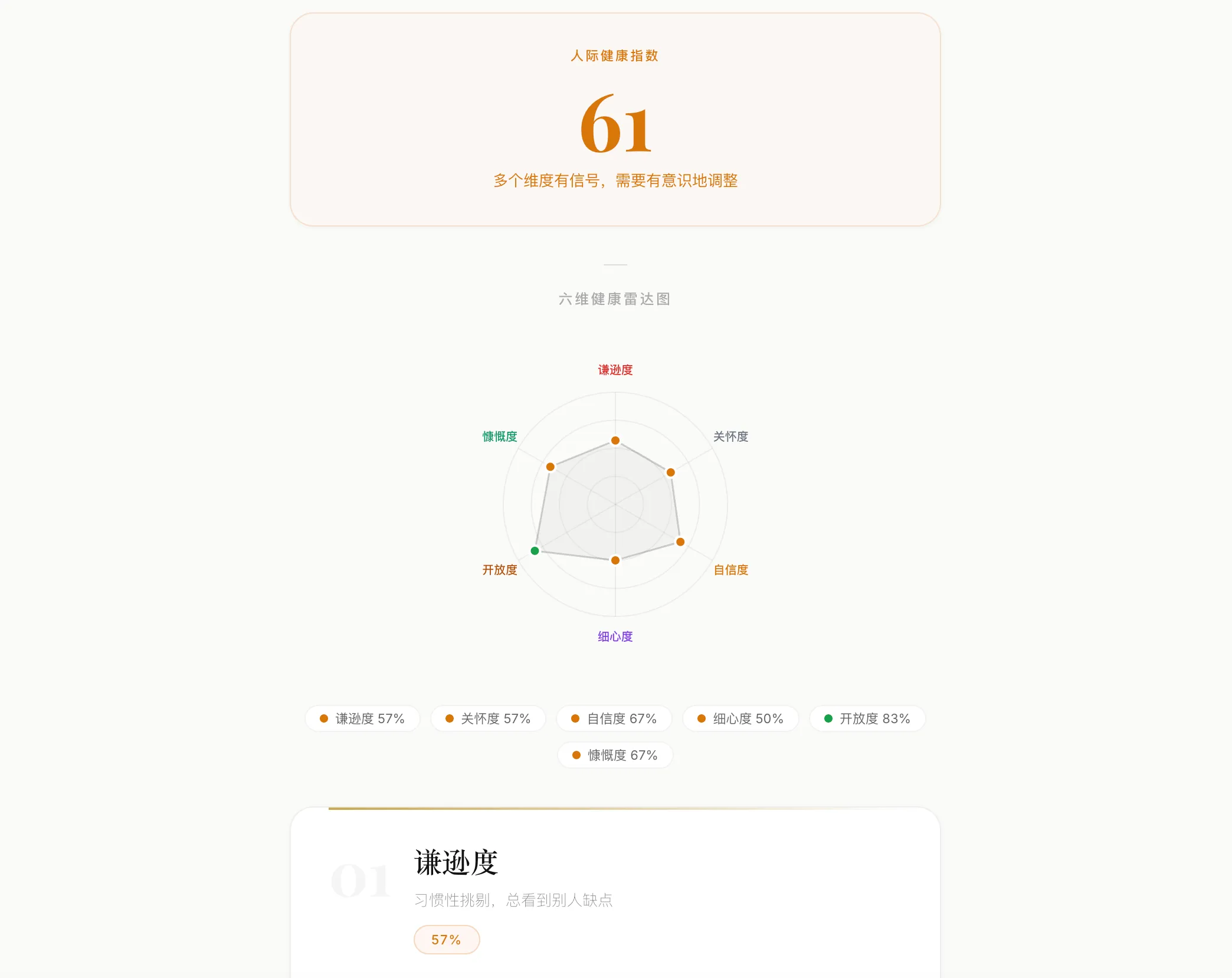
Result page: an overall index, six-dimension profile, and layered analysis connect observation to concrete action.
Why I did not add generative AI
The current experience does not need a model to calculate or explain the core result. Deterministic content is faster, easier to test, and more consistent with the limited evidence behind the framework. Adding generative text would increase uncertainty without solving the most important product problem.
Visual and interaction design
The interface uses restrained typography, whitespace, soft contrast, and a clear single-task flow. Mobile completion was treated as a primary condition. Animation and decoration remain secondary to readability, progress, and reliable interaction.
From the first version to the current version
Iteration focused on narrowing the product boundary, rewriting questions, improving score balance, clarifying the result hierarchy, fixing responsive behavior, and replacing temporary presentation with a maintainable structure.
Technical implementation
The project includes the test flow, deterministic scoring, result generation, input and route handling, responsive front-end behavior, deployment configuration, and production checks. Secrets and server settings remain outside the public client bundle.
My contribution
I defined the product, organized the content framework, wrote and revised the questions, designed the scoring rules and result structure, implemented the front and back ends with AI collaboration, tested the full flow, and deployed the public version.
Current outcome
The first version is publicly accessible. A visitor can enter, complete all 25 questions, receive a stable six-dimension result, and review detailed observations on desktop or mobile.
Limits and next step
The framework is not a validated psychological measure, and the current sample is not sufficient for strong statistical conclusions. The next priority is to observe completion, question comprehension, score distribution, and whether result language helps reflection without overclaiming.